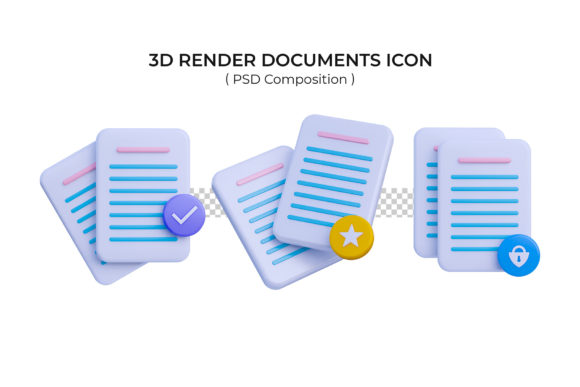
Evaluating the Documents Icon Stack of Paper for Professional Design Projects
In the realm of digital interface design and corporate branding, visual clarity is paramount. Designers frequently rely on intuitive symbols to communicate complex actions or statuses quickly. Among these, the Documents Icon Stack of Paper has emerged as a versatile asset for representing file management, approval workflows, and administrative tasks. This specific graphic element, often available as a high-quality 3D render with accompanying PSD and PNG files, offers a modern aesthetic that bridges the gap between flat minimalism and realistic depth. Understanding the utility, technical specifications, and strategic application of this icon stack is essential for designers seeking to enhance user experience without compromising visual coherence.
Understanding the Asset and Its Visual Appeal
The Documents Icon Stack of Paper typically depicts multiple sheets of paper layered together, often accompanied by visual cues such as checkmarks, clips, or subtle shadows to indicate organization and completion. Unlike traditional two-dimensional line icons, the 3D render version provides a tangible sense of weight and presence. This depth can make interface elements feel more interactive and engaging, particularly in applications where users manage significant amounts of data or documentation.
The availability of this asset in various formats, including PSD files with smart objects and high-resolution PNG files, underscores its flexibility. A PSD file with smart objects allows designers to non-destructively edit colors, textures, and lighting effects, ensuring the icon aligns perfectly with a brand’s specific color palette. Meanwhile, PNG files offer immediate usability for web developers who need lightweight, transparent-background images that load quickly across different platforms. This dual-format approach caters to both the creative customization needs of graphic designers and the practical implementation requirements of front-end developers.
Strategic Benefits for Business and User Interface Design
One of the primary reasons professionals seek out a confirmed or approved document business icon is its ability to convey status instantly. In workflow management systems, CRM platforms, or legal tech applications, distinguishing between a draft, a pending review, and an approved document is critical. The stack of paper imagery, especially when combined with approval indicators like a green checkmark or a stamp, reduces cognitive load for users. They do not need to read text labels to understand the state of a file; the visual cue suffices.
Furthermore, the 3D aesthetic contributes to a modern, polished look that can elevate the perceived quality of an application. While flat design remains popular for its simplicity, there is a growing trend toward "soft 3D" or neumorphic styles that add subtle realism. Using a high-quality 3D render of a document stack can help a product stand out in a crowded market where many competitors still rely on generic, flat vector icons. This differentiation can subtly influence user trust, as higher-quality visuals are often subconsciously associated with higher-quality service.
Technical Considerations and Editing Capabilities
When evaluating whether to integrate this icon into a project, technical compatibility is a key consideration. The mention of smart objects in the file description is significant for design teams. Smart objects in Photoshop preserve an image’s source content with all its original characteristics, enabling you to perform non-destructive editing. For a Documents Icon Stack of Paper, this means a designer can easily change the color of the paper from white to off-white or branded colors, adjust the shadow intensity to match the lighting of the surrounding interface, or modify the angle of the stack if necessary. This ease of editing reduces the time spent on asset customization and ensures consistency across a large design system.
However, it is important to note the tradeoffs associated with 3D renders compared to vector graphics. While PNGs are easy to implement, they are raster images. This means they can lose clarity if scaled up beyond their original resolution. For responsive web design, where icons must look sharp on both mobile screens and large desktop monitors, designers must ensure they have access to multiple resolutions or consider using SVG alternatives if scalability is a priority. If the provided asset is strictly a 3D render without a vector counterpart, careful attention must be paid to export settings to maintain crisp edges at various sizes.
Situations Where This Icon Is a Strong Fit
The Documents Icon Stack of Paper is particularly effective in contexts where the volume of information is a central theme. For example, in cloud storage interfaces, accounting software, or human resources portals, users often deal with batches of files rather than single documents. A single sheet icon might imply a solitary file, whereas a stack suggests a collection, folder, or archive. This semantic distinction helps users mentally model the structure of their data.
Additionally, this icon is well-suited for onboarding screens or tutorial overlays where the goal is to guide users through a process involving document submission or approval. The friendly, approachable nature of a 3D rendered object can make bureaucratic processes feel less intimidating. In marketing materials, such as landing pages for SaaS products focused on productivity, using a visually rich icon can draw attention to key features like "Easy Document Approval" or "Secure File Storage," making the value proposition immediately clear.
When to Consider Alternatives
Despite its advantages, the 3D document stack is not always the optimal choice. In highly data-dense dashboards where space is at a premium, detailed 3D icons can create visual noise. In these scenarios, simple line icons or solid glyphs are often more effective because they occupy less pixel space and reduce visual clutter. If the design language of the application is strictly minimalist or monochromatic, a colorful 3D render might clash with the overall aesthetic, requiring significant modification to fit in.
Moreover, accessibility considerations must play a role in the decision-making process. Complex 3D icons can sometimes be difficult to interpret for users with visual impairments if the contrast is low or the details are too fine. It is crucial to ensure that any icon used is accompanied by appropriate alt text and, where necessary, redundant text labels. If the primary goal is maximum accessibility and speed, a high-contrast, simple vector icon may be a more reliable alternative than a detailed 3D render.
Making the Right Decision for Your Project
Choosing the right visual asset involves balancing aesthetic goals with functional requirements. If your project benefits from a modern, tactile feel and requires clear communication of document status or volume, the Documents Icon Stack of Paper is a strong candidate. The availability of editable PSD files and ready-to-use PNGs adds significant value by streamlining the workflow for both designers and developers.
Before finalizing your selection, evaluate the technical constraints of your platform. Ensure that the resolution of the PNG files meets the demands of high-density displays, or verify that your team has the skills to leverage the smart object features in the PSD file for custom adaptations. By carefully considering these factors, you can determine whether this specific icon aligns with your user experience goals and brand identity, ultimately leading to a more intuitive and visually appealing product.