Strategic Direction: Leveraging the Arrow Vector Collection for Clearer Communication
In the architecture of modern web design, clarity is not merely an aesthetic preference; it is a functional necessity. Every element on a screen competes for cognitive attention, and the margin for user confusion is razor-thin. This is where the Arrow Vector Collection transitions from a simple graphic asset to a critical component of user experience strategy. These are not just decorative shapes; they are visual directives that guide decision-making, streamline navigation, and establish hierarchy.
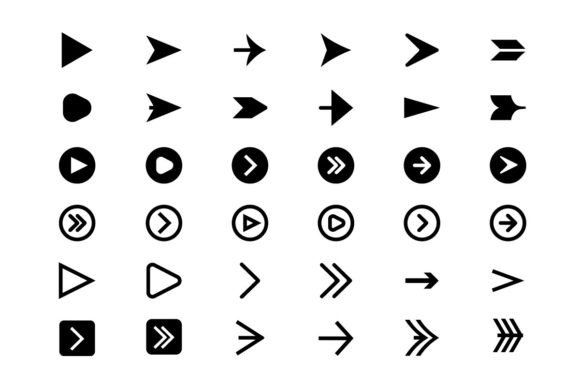
The specific utility of a simple arrows icon set using a flat style with a black and white color scheme lies in its neutrality and adaptability. By stripping away unnecessary ornamentation, these icons force the viewer to focus on direction and action rather than style. For entrepreneurs, marketers, and designers, understanding how to deploy these assets intentionally can significantly impact conversion rates, operational efficiency, and brand coherence.
The Psychology of Direction in Digital Interfaces
Human beings are hardwired to follow visual cues. An arrow is perhaps the most universally recognized symbol for "next," "forward," or "look here." When you integrate an arrow vector collection into your digital properties, you are tapping into this innate behavioral response. However, the effectiveness of this cue depends entirely on context and consistency.
Consider the difference between a chaotic interface and one that uses modern simple arrows to create a logical flow. In the former, users hesitate, scan randomly, and often abandon the task. In the latter, the path is clear. The big black set icons provide high contrast against lighter backgrounds, ensuring that the directive is impossible to miss. This is particularly crucial for call-to-action buttons, tutorial overlays, and complex data visualizations where the user must understand the relationship between different data points.
Using a cursor or pointer icon in conjunction with directional arrows can further enhance this effect, simulating human interaction and guiding the eye to specific interactive elements. This subtle mimicry of physical pointing reduces the cognitive load required to understand what action is expected next.
Why Flat Style and Monochrome Palette Matter
The choice of a flat style isolated on a white background is a strategic design decision, not just a trend. Flat design removes depth, shadows, and gradients, which reduces visual noise. In a world where users are bombarded with information, reducing noise is a competitive advantage.
- Versatility: A black and white color scheme ensures that the arrow icon can be placed over any brand color without clashing. It acts as a neutral framework that supports your primary branding rather than competing with it.
- Scalability: As a vector illustration, these icons remain crisp at any size. Whether used as a tiny bullet point in a mobile menu or a large directional indicator on a desktop landing page, the edges remain sharp. This scalability is essential for responsive design, where assets must adapt to various screen resolutions.
- Load Speed: Simple vector files are lightweight. Using a streamlined arrow vector collection contributes to faster page load times, which is a direct ranking factor for search engines and a key determinant of user retention.
When you choose a simple arrows icon set, you are prioritizing function over flair. This aligns with the principles of minimalist design, where every element must earn its place on the screen. If an arrow does not clarify a process or guide a user, it should not be there.
Strategic Applications Across Business Functions
The utility of the Arrow Vector Collection extends beyond basic navigation. Thoughtful application can support various business goals, from marketing conversions to internal operational clarity.
Enhancing User Onboarding and Education
For SaaS platforms and educational tools, the initial user experience is critical. Complex software can overwhelm new users. By using modern simple arrows to highlight key features during onboarding, you reduce friction. A well-placed arrow can draw attention to a "Save" button or explain a dropdown menu without requiring lengthy text explanations. This visual shorthand accelerates the learning curve, leading to higher adoption rates and lower support costs.
Optimizing Conversion Funnels
In e-commerce and lead generation, the goal is to move the user through a funnel. Arrows serve as psychological nudges. An arrow pointing toward a checkout button or a sign-up form creates a visual momentum that encourages completion. However, this must be done with subtlety. Overusing big black set icons can create a sense of urgency that feels aggressive rather than helpful. The key is to use them to clarify the next step, not to pressure the user.
Clarifying Data and Processes
For consultants, analysts, and educators, communicating complex processes is a daily challenge. Flowcharts and infographics rely heavily on directional cues. A consistent arrow vector collection ensures that the logic of your diagram is easy to follow. When all arrows share the same weight, style, and color, the viewer can focus on the content of the boxes rather than deciphering the connectors. This consistency builds trust in the accuracy and professionalism of the information presented.
Risks of Indiscriminate Use
While the Arrow Vector Collection is a powerful tool, it is not without risks if used without strategic intent. The most common mistake is redundancy. If your layout already clearly indicates the flow of content—for example, a standard left-to-right reading pattern—adding arrows may be unnecessary clutter.
Another risk is inconsistency. Mixing different styles of arrows—some flat, some 3D, some hand-drawn—creates visual dissonance. This undermines brand authority and makes the interface feel amateurish. Stick to one cohesive set, such as the simple arrows icon set with a uniform flat style, to maintain professional integrity.
Furthermore, consider accessibility. While black and white offers high contrast, ensure that arrows are not the sole method of conveying information. Screen readers may not interpret a graphic arrow as a directive. Always pair visual cues with descriptive text or ARIA labels to ensure your content is accessible to all users.
Implementation Guidelines for Decision-Makers
To maximize the value of your arrow vector collection, approach its implementation with a plan. Do not simply drop icons onto a page; integrate them into your design system.
- Audit Your Current Flow: Identify areas where users hesitate or drop off. Are there steps in your checkout process that are unclear? Is your navigation menu confusing? These are the prime candidates for directional cues.
- Standardize Your Assets: Select a single arrow icon style and stick to it. Define rules for size, color, and placement. For instance, use right-pointing arrows for progression and down-pointing arrows for expansion. Consistency builds intuition.
- Test for Clarity: Conduct A/B tests to see if adding arrows improves click-through rates or reduces time-on-task. Data should drive your design decisions, not assumptions.
- Maintain Simplicity: Resist the urge to animate every arrow or add complex effects. The strength of the flat style is its simplicity. Let the direction do the work.
By treating the Arrow Vector Collection as a strategic asset rather than a decorative afterthought, you enhance the usability and effectiveness of your digital presence. Whether you are building a brand, teaching a concept, or selling a product, clear direction leads to better outcomes. The right arrow, in the right place, at the right time, can be the difference between confusion and conversion.
Ultimately, the goal of using modern simple arrows is to respect the user’s time and attention. In an economy of scarcity, clarity is a luxury. By leveraging these clean, versatile, and impactful vector illustrations, you provide that luxury, fostering trust and facilitating action. Make every pixel count, and let direction drive your results.